Why a Qualified Electronic Seal KSeF Poland Is a Key?
Poland introduces mandatory B2B electronic invoicing via the Krajowy System E-Faktur platform. This system introduces strict regulatory friction for unprepared international enterprises. Deploying a qualified electronic seal KSeF Poland framework remains the ultimate solution. It allows seamless generation of structured XML invoices without manual intervention. Automated billing authentication eliminates operational bottlenecks for high-volume corporate systems. Foreign companies face severe challenges when managing compliance across borders.
Enterprise technology architecture must adapt swiftly to these local regulatory updates. Traditional PDF documentation no longer holds legal validity. Every commercial transaction requires real-time central clearance through state databases. Consequently, choice of automated authentication dictates operational velocity.
Understanding the KSeF 2026 Legal Framework in Poland
The Ministry of Finance mandates strict electronic interaction models. Every domestic commercial invoice must traverse a centralized state repository.
Is an electronic seal mandatory for KSeF in Poland?
Legal text indicates that an electronic seal is not strictly mandatory by law. Taxpayers can technically select alternative verification paths. However, alternative paths introduce heavy operational burdens for corporate groups. Natural persons can utilize a personalized certificate or a basic trusted profile. Nevertheless, manual systems fail completely when applied to automated corporate infrastructures.
Phased Timelines for Large and Mid-Sized Enterprises
Large market players faced mandatory compliance starting February 1, 2026. This threshold targets entities exceeding PLN 200 million in annual revenue. Furthermore, all remaining VAT-registered entities must fully integrate by April 1, 2026. Non-compliance results in severe financial penalties and blocked tax deductions. Corporate entities must protect their billing continuity before enforcement windows close.
Transitioning to the New FA(3) Schema Compliance
The transition from legacy structures to the FA(3) logical schema is highly complex. The updated schema introduces rigorous data field requirements. For instance, invoice attachments must follow strict formatting guidelines. Systems must handle precise currency valuations and complex split-payment markers. A corporate electronic seal guarantees that transmitted datasets remain structurally unaltered.
Qualified Electronic Signature vs. Qualified Electronic Seal
Corporate decision-makers often confuse individual signatures with institutional electronic seals. Both mechanisms utilize asymmetric cryptography but serve entirely distinct operational purposes.
The PESEL Bottleneck for Foreign Board Members
A qualified electronic signature links directly to a specific natural person. The setup requires verification of individual identification vectors like a PESEL number. However, international executives often lack local registration records within the National Court Register (KRS). Forcing a foreign CEO to undergo identity verification via a local Voivodeship Office introduces massive operational delays.
Furthermore, this individual tracking disrupts automated software processing. If a board member resigns, your entire financial data transmission pipeline breaks instantly.
Machine-to-Machine (M2M) Invoicing Autonomy
A qualified corporate seal represents the legal entity rather than an individual worker. The underlying certificate embeds your corporate NIP and formal corporate designation. Therefore, your enterprise software functions independently without human intervention. The system seals and transmits documents around the clock.
Operational Insight: An organizational seal shifts the legal liability of invoice generation from an individual accountant to the corporate entity.
Structural Architecture for Automated B2B Invoicing
High-volume transaction networks require absolute system stability. Relying on temporary access tokens introduces unnecessary operational vulnerabilities.
How can a company automate invoice validation in KSeF?
Integrating a cloud-native cryptographic seal directly into your ERP platform is highly effective. The financial software builds the structured XML invoices automatically. Then, the application applies the corporate seal using secure API handshakes. The document uploads to the national platform without manual human validation.
Consequently, your internal billing loops remain swift and safe. The central platform returns a unique identification number instantly.
What is the best way to authenticate a business system with KSeF?
Deploying an enterprise-grade Asseco Certum e-seal provides maximum technical reliability. It allows your IT infrastructure to maintain permanent access authorization. Hardware security modules protect your digital keys in the cloud. As a result, system administrators avoid the tedious process of renewing individual user permissions.
Furthermore, this centralized setup simplifies internal IT compliance management. Your database tracks all transactional history through a single secure gateway.
Methods of KSeF Authentication
The table below compares the primary compliance instruments available for enterprise authentication.
| Authentication Method | Identity Bound To | Requires PESEL? | Ideal For | Automation Level |
| Trusted Profile (ePUAP) | Natural Person | Yes | Micro-businesses | None (Manual) |
| Qualified Signature | Natural Person | Yes / No (With Passport) | Individual Sign-offs | Low (Requires User Prompt) |
| KSeF User Token | Specific System Session | No | Basic API Software | Medium (Risk of Expiration) |
| Qualified Electronic Seal | Legal Entity (NIP) | No | Enterprise ERP Systems | High (Fully Automated 24/7) |
Strategic Integration of Corporate Mobility and Tax Controls
International commercial expansion requires unified compliance management across all departments. Tax automation must align perfectly with global mobility programs.
Our multi-disciplinary team of Polish corporate attorneys, certified accountants, and licensed HR compliance specialists handles end-to-end relocation, statutory audits, and market integration pathways under government employment agency license number 34916.
Aligning Global Talent Systems with Fiscal Frameworks
Foreign professionals entering Poland frequently require specialized administrative processing. Relocation teams manage filings with the local Office for Foreigners to secure entry visas. Highly-qualified foreign personnel often apply for a Temporary Residence Card (TRC) or an EU Blue Card.
In addition, corporate documents from parent organizations require an official Apostille. Legalization workflows move through the Ministry of Foreign Affairs and the Ministry of Justice.
Mitigating Cross-Border Legal Liabilities
Regulatory friction arises when local tax mandates clash with global corporate habits. Foreign headquarters often expect standard European data transmission models. However, Poland’s rigid framework demands exact local integration.
Utilizing certified sworn translator Warsaw services ensures all foreign corporate charters match local requirements. Clear legal documentation accelerates system validation loops.
Technical Implementation and Risk Containment
Enterprise integration demands proactive system risk mitigation. IT teams must establish clear failover protocols before the final 2026 enforcement deadlines.
| Integration Phase | Core Objective | Technical Requirement | Risk Factor |
| Phase I | System Audit | Map data fields to FA(3) layout | Legacy data gaps |
| Phase II | Seal Deployment | Implement cloud HSM credentials | Access configuration errors |
| Phase III | API Testing | Validate production handshakes | Firewall blocks |
| Phase IV | Live Processing | Monitor real-time XML acceptances | System downtime |
Managing Offline Invoicing and System Unavailability
The national system occasionally experiences technical maintenance breaks. During outages, companies must use emergency offline invoicing modes. The law requires businesses to generate specific authorization codes. An integrated corporate seal allows your ERP to compile these codes automatically.
Therefore, your warehouse logistics move forward without interruption. The software queues the sealed files for transmission once connectivity returns.
Safeguarding Proprietary Corporate Ledger Data
Data security remains a paramount concern for multinational enterprise networks. Passing unencrypted commercial records through external portals exposes sensitive client information. An organizational seal creates an immutable cryptographic envelope around every transaction.
As a result, malicious actors cannot alter pricing details during transmission. Your brand identity stays protected across public networks.
Procuring and Deploying an E-Seal
Follow this clear operational sequence to secure your corporate digital identity.
- Corporate Verification:
Extract active records from the National Court Register (KRS) to verify current management representation.
2. Provider Selection:
Engage an approved Qualified Trust Service Provider (QTSP) such as Asseco Certum.
3. Identity Validation:
Complete remote video verification of authorized corporate signatories using international passports.
4. Cryptographic Issuance:
Receive the cloud-based HSM seal linked directly to your corporate NIP.
5. ERP Cloud Integration:
Embed the seal into your automated billing infrastructure to activate direct API communication.
Common Mistakes
Enterprises frequently mismanage their digital keys by relying on personal employee signatures for corporate-level processing. This creates severe compliance vulnerabilities during standard personnel transitions. Furthermore, utilizing physical smart cards inside high-volume data centers introduces hardware lag and frequent authentication timeouts.
Executive Summary and Strategic Takeaways
Navigating the digital transformation landscape in Poland requires decisive administrative action. Corporate leaders must prioritize long-term system architecture over temporary manual workarounds.
- Permanent Operational Autonomy: An electronic seal isolates your invoicing pipeline from corporate personnel changes.
- Complete PESEL Elimination: Foreign board members avoid complex local identity registration loops.
- 24/7 Automated Scalability: Your ERP platform authenticates high-volume transfers without human prompts.
- Absolute Regulatory Protection: Early deployment eliminates the risk of systemic tax penalties.
International organizations must act immediately to secure their automated digital frameworks. Integrating a qualified electronic seal KSeF Poland asset protects your operational continuity.
Frequently Ask Questions (FAQ)
Q: Is an electronic seal mandatory for KSeF in Poland?
A: No, it is not legally mandatory, as companies can technically use individual signatures instead. However, a qualified electronic seal KSeF Poland setup is practically essential for any enterprise seeking to automate high-volume invoicing.
Q: How can a company automate invoice validation in KSeF?
A: Automation is achieved by embedding an organizational certificate directly into your corporate ERP architecture. This setup allows the system to apply a qualified electronic seal KSeF Poland marker and transmit XML files without human intervention.
Q: What is the best way to authenticate a business system with KSeF?
A: The most reliable method is utilizing a cloud-based corporate electronic seal linked to the company’s NIP. This creates a secure, permanent machine-to-machine connection independent of individual employee credentials.
Q: Can this company operational setup be handled completely remotely?
A: Yes, foreign enterprises can complete the entire procurement and system integration process online. Trusted providers utilize secure remote video identification to verify foreign board members without requiring local travel.
Q: What are the explicit document requirements for procurement?
A: Applicants must supply recent extracts from the National Court Register alongside valid corporate structural charters. Foreign board members must present their valid international passports during the secure remote identity verification session.
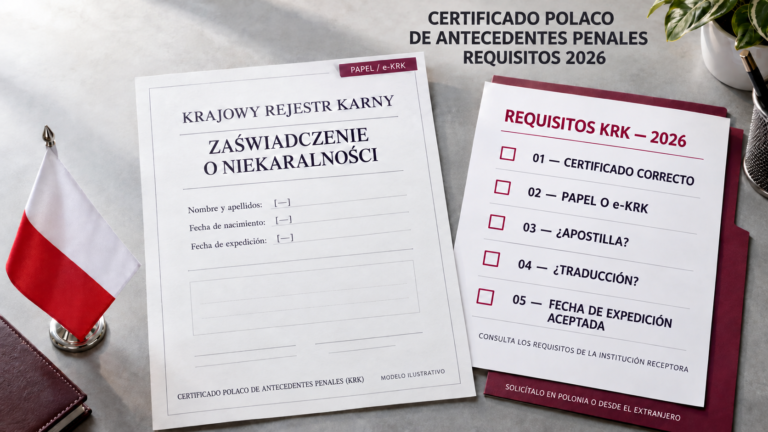
Potrzebujesz zaświadczenia o niekaralności z Polski?
Lex Corporation wspiera klientów w Polsce i za granicą w uzyskaniu zaświadczenia o niekaralności, przygotowaniu pełnomocnictwa, apostille, tłumaczenia przysięgłego oraz międzynarodowej wysyłce dokumentów.
Take Action Today
Do not allow missing paperwork to disrupt your global plans. Let the cross-border specialists at Lex Corporation deliver your certified, apostilled Poland Police Clearance Certificate for visa purposes directly to you — fast, remotely, and without stress.
Website: Lex Corporation
Email: info@lexcorporation.pl
WhatsApp: +48 573 467 138
List
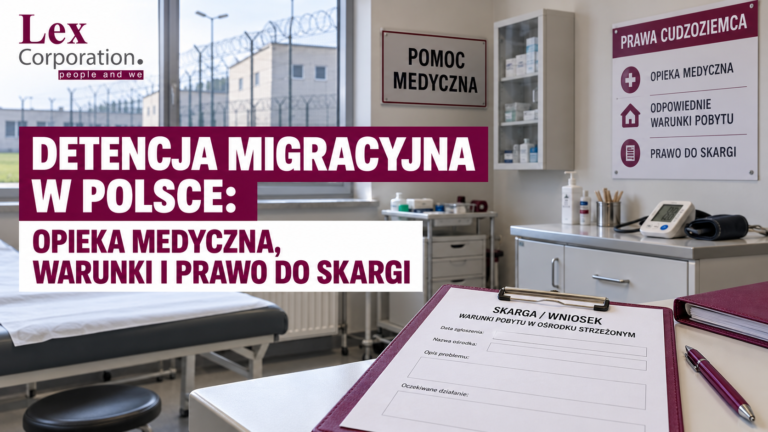
Prawa cudzoziemca w ośrodku strzeżonym: zdrowie, warunki i skargi

Rights in Immigration Detention in Poland: Health, Conditions and Complaints
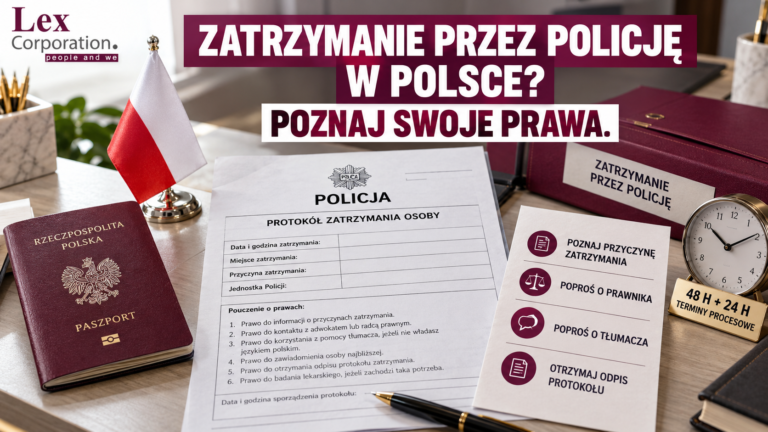
Zatrzymanie cudzoziemca przez policję w Polsce: prawa i dalsze kroki
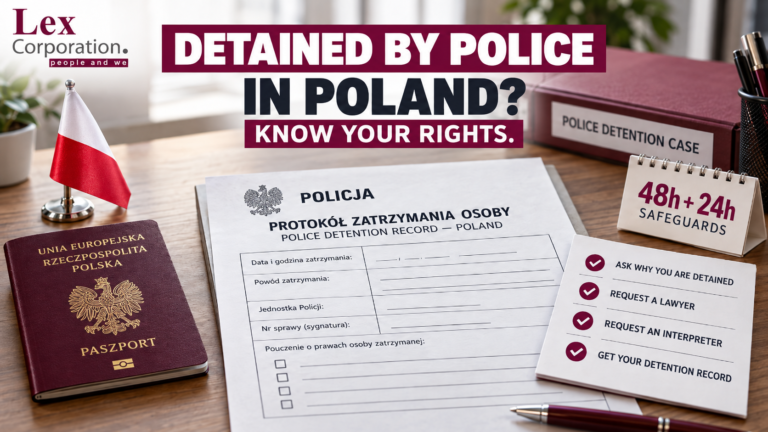
Police Detention in Poland: A Foreigner’s Rights and Next Steps
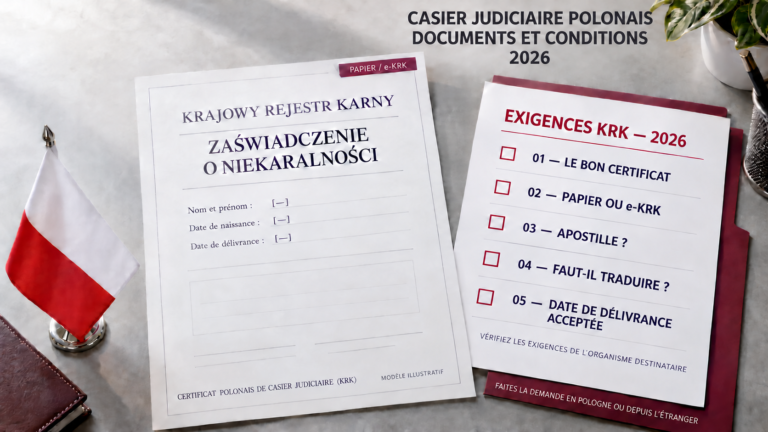
Comment vérifier les conditions d’obtention d’un certificat de casier judiciaire polonais (2026)