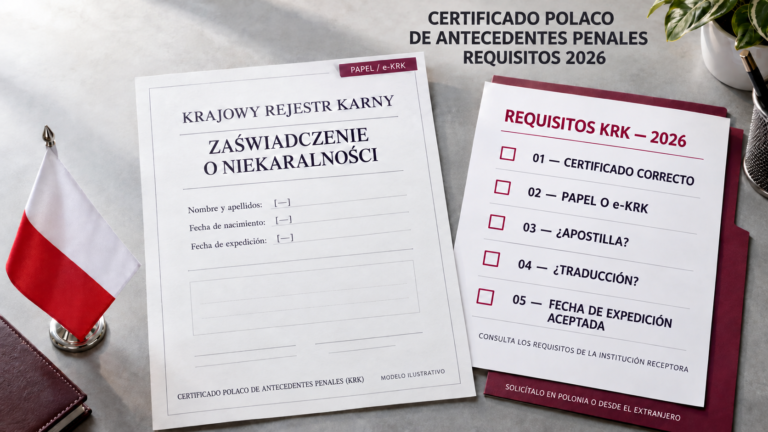
If you’ve spent any real time living, working, or studying in Poland, chances are you’ve already run into a request for one specific document: the zaświadczenie o niekaralności – Poland’s official criminal record certificate. Here’s what it is, when you’ll need it, and the three legitimate ways to actually get one.
What the zaświadczenie o niekaralności actually is
The National Criminal Register (Krajowy Rejestr Karny, KRK) issues the certificate, and it confirms one thing: whether you appear in Poland’s criminal records database. If you’ve ever been convicted of an offense in Poland, that record lives in the KRK system – for individuals and legal entities alike.
The paper version is a single A4 sheet carrying your personal details and the office’s official stamps. Printing out the digital e-KRK file does not produce a valid paper document. Many foreign authorities only accept one specific format. Therefore, always confirm the requirements before you apply.
When you’ll actually need one
A few situations come up again and again:
- Working with children – employers routinely require nannies, teachers, and childcare workers to show a clean record.
- Bank loans – some lenders request it as part of a loan application.
- Regulated professions – roles like accountant, broker, or other financial-market positions often require it.
- Licenses and permits – taxi licenses, firearms permits, and similar require proof of a clean record.
- Starting a business – authorities frequently ask company founders and directors in Poland for one.
Three ways to get your zaświadczenie o niekaralności
Important first: the paper and electronic versions are not interchangeable. Printing out the digital e-KRK file does not produce a valid paper certificate – many offices and foreign authorities will only accept one specific format, so it’s worth confirming which one you actually need before you apply.
Option 1 – In person at a KRK information point
You don’t need to book an appointment in advance. Walk into any KRK information point (these operate out of regional courts) and:
- Pay the official fee – currently 30 PLN for a paper certificate – via court stamp or at the cashier’s desk.
- Fill out the application form, which asks for your full name, date of birth, PESEL number (if you have one), current address, parents’ names, your mother’s maiden name, and place of birth.
- Sign the form and attach proof of payment.
- Submit the form with your ID.
In most cases, you’ll walk out with the certificate the same day – official rules allow up to 7 days, but in practice it’s often issued on the spot.
Option 2 – Online through e-KRK
This route requires a Trusted Profile (Profil Zaufany), a qualified electronic signature, or an e-ID – you’ll need one of these to verify your identity and sign the application digitally. Once registered:
- Complete the application through the e-KRK system.
- Pay the fee electronically – currently 20 PLN, the cheaper of the two standard options.
- Receive the certificate as a digital file, typically within a few days.
The catch: this produces an electronic document, not a printable paper original. If a foreign authority specifically needs the paper version – for example, so it can carry an apostille – this route won’t get you there on its own.
Option 3 – By post
Functionally similar to the in-person route, minus the trip:
- Download the application form (a separate version exists for individuals versus legal entities).
- Fill it out and attach proof of payment (30 PLN).
- Mail it to any KRK information point or the KRK Information Bureau in Warsaw.
- The certificate is mailed back to the address you provided, usually within about 7 days.
Who can apply
Both Polish citizens and foreign nationals can apply for this certificate – Polish residency isn’t a requirement to request your own record. If you can’t handle the application yourself, you can authorize someone else to do it for you through a Power of Attorney, which carries its own small fee (currently 17 PLN, waived for close family members such as a spouse, children, parents, or siblings).
Common Mistakes When Applying from Abroad
One of the most frequent errors applicants make when trying to obtain their zaświadczenie o niekaralności from abroad is assuming the e-KRK digital file is universally accepted. As mentioned earlier, this digital XML file lacks the physical wet ink stamps required by most international embassies, immigration offices, and foreign employers.
Another common pitfall is incorrect personal data entry. The Polish registry cross-references your application with multiple internal databases. A misspelled mother’s maiden name, a missing previous surname, or a typo in your PESEL number can lead to an outright rejection of your application. Finally, many expats underestimate the time required for postal delivery. If you choose to apply by post from outside of Poland, international mail delays can push the processing time from a few days to several weeks.
Where this gets complicated for people abroad
Everything above assumes you can either show up in Poland or navigate a Polish-language government portal with the right digital credentials. If neither is true – you’re settled abroad, you don’t have a Trusted Profile, and the deadline is real – this is exactly the gap a licensed representative closes: applying under Power of Attorney, collecting the paper original, arranging an apostille where needed, and getting a sworn translation done, all without you needing to be in Poland.
That’s the service Lex Corporation runs for clients living outside Poland.
Contact Lex Corporation
Website: https://lexcorporation.pl/
WhatsApp: +48 573 467 138
Email: info@lexcorporation.pl
List
Prawa cudzoziemca w ośrodku strzeżonym: zdrowie, warunki i skargi
Rights in Immigration Detention in Poland: Health, Conditions and Complaints
Zatrzymanie cudzoziemca przez policję w Polsce: prawa i dalsze kroki
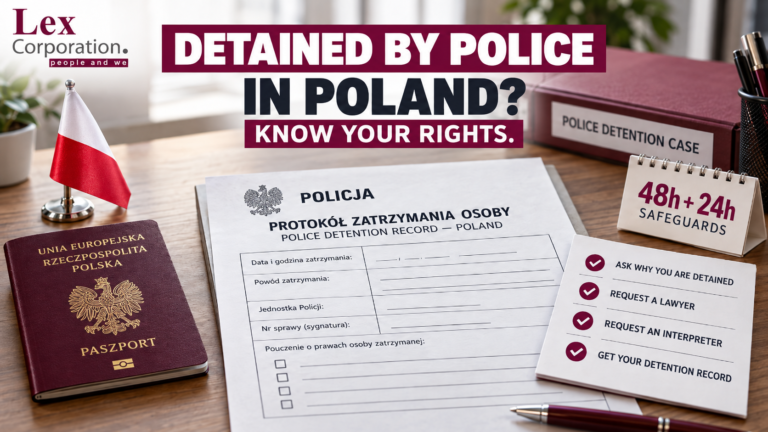
Police Detention in Poland: A Foreigner’s Rights and Next Steps
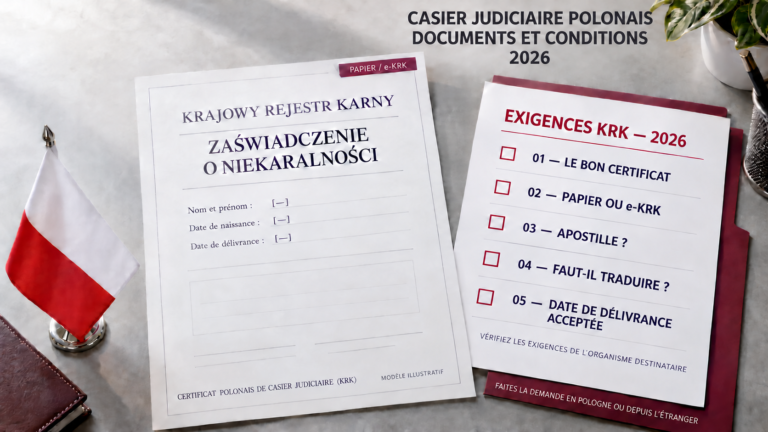
Comment vérifier les conditions d’obtention d’un certificat de casier judiciaire polonais (2026)