The Question HR Teams and Remote Workers Keep Asking
You just hired someone in Warsaw, or you are a candidate starting a new role in Kraków. Nobody shares the same office. This raises a straightforward question: can you sign an employment contract online in Poland, or must you still print and sign it physically?
If you searched for this, you are not alone. Poland’s remote-work sector is growing fast, and the country remains a top destination for foreign talent. Because of this digital shift, HR managers and business owners frequently face this compliance question in 2026.
The stakes are high. Getting this wrong causes more than just an inconvenience. Polish law can invalidate an improperly signed contract. This exposes the employer to inspections, fines, and costly labour court disputes.
The Short Answer
Yes, you can sign an employment contract online in Poland. However, the legal value depends entirely on the type of electronic signature you use.
The Polish Labour Code requires a strict written form for employment contracts. Only a Qualified Electronic Signature (QES) meets this legal requirement. This signature must comply fully with the EU eIDAS Regulation.
Popular tools like basic DocuSign, PandaDoc, or scanned PDFs do not meet Polish legal requirements for employment contracts. Using them creates a document that looks signed but lacks legal protection. The employer remains exposed to challenges from employees, labour inspectors, and the courts.
Understanding the Legal Hierarchy: Not All E-Signatures Are Equal
The EU eIDAS Regulation (Regulation 910/2014) defines three tiers of electronic signature. Each tier carries a different legal weight. Poland adopts this framework fully. Here is what each tier means for your employment documents.
Tier 1: Simple Electronic Signature (SES)
This is the lowest level. Clicking “I agree” or drawing a signature in a PDF are examples of SES. These platforms offer no identity verification or tamper protection. They work fine for low-stakes acknowledgements, but Polish law rejects them for employment contracts.
Tier 2: Advanced Electronic Signature (AES)
An AES verifies identity more rigorously. It usually uses a mobile phone number, email verification, or an ID check. It also links securely to the document content to make tampering detectable. Many popular e-signature platforms operate at this level. They suit commercial agreements but fail the Polish Labour Code’s written requirements.
Tier 3: Qualified Electronic Signature (QES)
A QES is the only signature type that matches a handwritten (wet ink) signature under Polish law. A certified Trust Service Provider (TSP) on the EU Trusted List must issue it. In Poland, this includes providers like Certum by Asseco Data Systems. You create the signature using a qualified certificate after a strict identity check. Once set up, you can sign documents instantly from a phone or computer.
| Feature | Basic / SES | Advanced / AES | Qualified / QES |
| Examples | DocuSign click-to-sign, scanned PDF | Adobe Sign with ID verification | Certum SimplySign, smart card |
| Verifies Identity? | No | Partially | Yes (EU-certified) |
| Valid for Polish Employment? | No | No | Yes (Full equivalence) |
| eIDAS Compliant? | No | Partially | Fully |
| Admissible in Polish Courts? | Disputed | Limited | Yes (Acts like wet ink) |
An Important Legal Nuance: Both the employer and employee must use a QES to make the electronic contract valid. If the employee lacks a QES, companies often use a hybrid approach. The employer signs digitally with their QES, then prints and mails the copy to the employee for a wet-ink signature. The HR team then retains both versions on file. This hybrid route is fully compliant and highly practical for gradual digital rollouts.
Why This Matters for Your Business: Real-World Workflow Scenarios
Understanding the law is one thing. Seeing how it impacts daily operations is another. Here are three common situations where your choice of electronic signature matters.
Scenario 1: Onboarding a Remote Employee in Poland
Your new hire lives 600 km away from your Warsaw office. Polish regulations state you must provide the employment contract by the first day of work. The document requires a physical written form or a mutual QES. A standard DocuSign link fails this standard and leaves your business without a legally binding document.
When you deploy a QES across your HR team, onboarding becomes easy. Whether the employee uses their own QES or you use the hybrid approach, the entire workflow remains paperless and legally sound.
Scenario 2: Hiring Foreign Professionals
In July 2025, Poland introduced a new requirement. Employers must submit foreign workers’ contracts to the government “Praca” platform online before day one. This digital submission process requires strict document integrity. A QES provides tamper-evident proof of your agreement, locking in the terms and dates perfectly.
International companies bringing talent into Poland need a reliable solution. This includes IT firms, multinationals, and Employer of Record (EoR) providers. The QES solves cross-border compliance issues when meeting in person is impossible.
Scenario 3: Remote Work Agreements
Poland formalized its remote work framework in the Labour Code in April 2023. This framework requires remote work agreements to follow the exact same written standard as the main contract.
If you sign electronically, any agreement outlining remote hours and locations must use a QES. Many companies mistakenly assume basic e-signatures cover their remote work addenda. In practice, they are using legally fragile documents.
Scenario 4: Signing HR Documents Beyond the Contract
The qualified electronic signature is not only useful for the contract itself. Once your team or your employees hold QES credentials, you can sign non-competition agreements, confidentiality clauses (which also require written form under Polish law), termination notices, and financial statements all without printing a single page. Explore our Digital Start programme for businesses looking to digitise across multiple document types simultaneously.
For finance teams, this has additional value: KSeF, JPK, and ZUS declarations are already standard use cases for QES in Poland. Combining HR and finance signing under one certified signature tool reduces administrative overhead across departments and creates a unified, auditable document trail.
Certum: Poland’s Trusted Provider of Qualified Electronic Signatures
Once the legal need is clear, the next question is practical: where does a business or individual obtain a compliant qualified electronic signature in Poland?
Certum by Asseco Data Systems is one of Poland’s longest-established and most widely recognised EU Trust Service Providers (TSP). Certum QES certificates appear on the EU Trusted List, which means they are automatically recognised across all EU member states. They are also certified under the AATL (Adobe Approved Trust List), so documents signed with Certum credentials display a verified signature indicator in Adobe Reader without any additional configuration.
SimplySign: Cloud-Based, Mobile-First
SimplySign is Certum’s cloud-based qualified signature solution. Signing happens through a smartphone app with two-factor authentication, with no hardware card or USB reader required. It supports signing up to 15 documents per second and is designed for HR teams, remote workers, and anyone who signs regularly across multiple locations. Visit certum.eu to review current pricing and setup requirements.
Card & Reader Traditional and High-Security
For environments with strict IT security policies or regulated industries where hardware-based credentials are required, Certum also offers a physical smart card and USB reader option. Signing happens from a workstation with the card inserted familiar to many professionals already using ZUS or KRS tools.
Validity and Included Features
Certum offers up to 3-year certificate validity the longest available on the Polish market. Each certificate includes 5,000 qualified timestamps per month. The QES is accepted across all major Polish administrative systems: ePUAP, ZUS, KRS (National Court Register), e-KRK (National Criminal Register), Tax Office (e-Deklaracje), public procurement platforms, and standard B2B and B2C contract workflows.
For further reading on how this works in practice for financial documents, see our Polish-language resource: Jak podpisać sprawozdanie finansowe podpisem kwalifikowanym? — a detailed guide to signing financial statements digitally under Polish law.
How Lex Corporation Helps Businesses Implement the Right Solution
Understanding that you need a qualified electronic signature is one step. Deploying it correctly across your business for HR workflows, document management, and cross-border operations is another. That is where Lex Corporation comes in.
Lex Corporation is an official authorised partner of Certum by Asseco Data Systems, based in Warsaw at ul. Krucza 16/22. We act as a certified identity verification point and implementation partner, guiding businesses and individuals through the full process of obtaining and deploying qualified electronic signatures and qualified electronic seals in Poland.
Our team works across HR, business consultancy, legalization, and digital trust which means we understand not just the signature, but the full compliance context of employment in Poland. We serve startups entering the Polish market, established multinationals restructuring their HR workflows, and individual professionals who need a certified digital identity for their professional documents.
What We Support
- Identity verification appointments for Certum QES issuance conducted in person at our Warsaw office
- Guidance on selecting the right Certum product for your workflow: SimplySign vs card & reader
- Implementation consulting for companies integrating QES into HR, legal, and finance document processes
- Support for foreign nationals and international companies navigating Polish digital authentication requirements
- Qualified Electronic Seal deployment for organisations that need to stamp invoices, reports, and outgoing documents automaticallysee our Electronic Seal service page for details
If you are building or scaling an HR function in Poland, our HR & Recruiting services and Digital Trust services work together to cover both the people side and the document compliance side of your operations.
Ready to Move Your Employment Process Online: Correctly?
If your business is onboarding employees remotely, hiring foreign workers, or simply looking to eliminate paper from your HR process, the qualified electronic signature removes legal risk while making your workflow faster. The path from here is straightforward.
- Determine which members of your HR team and which employees need to sign employment documents
- Identify whether SimplySign (mobile, cloud-based) or a card-based solution fits your infrastructure
- Book an identity verification appointment at the Lex Corporation office in Warsaw
- Deploy and sign the entire employment contract exchange can be paperless and fully compliant from day one
Visit our Qualified Electronic Signature page to review available Certum products and current options, or book a consultation directly with our team. You can also reach us at info@lexcorporation.pl or visit us at ul. Krucza 16/22, Warsaw.
For organisations looking to go fully paperless across HR and finance in one move, explore the Digital Start programme bundled digital transformation support that combines signature issuance, electronic seal deployment, and implementation guidance in a single package.
Frequently Asked Questions
Is a DocuSign-signed employment contract valid in Poland?
No. Under the Polish Labour Code, an employment contract must be in written form. Polish courts and the Chief Labour Inspectorate do not recognise basic electronic signatures including DocuSign’s standard click-to-sign as satisfying this requirement. Only a Qualified Electronic Signature compliant with the eIDAS Regulation provides full legal equivalence to a handwritten signature.
Do both the employer and employee need a qualified electronic signature?
Yes, for a fully electronic employment contract. Both parties must sign with a QES. If the employee does not hold one, two compliant routes exist: the employer signs with their QES and a physical copy is sent to the employee for a wet-ink signature, or the employer assists the employee in obtaining a QES as part of the onboarding process.
What happens if the employment contract does not meet the written form requirement?
The contract is not automatically void, but it is legally fragile. The employer remains obligated to confirm the terms of employment in writing before work begins. If the employee disputes terms or files a complaint with the State Labour Inspectorate (Państwowa Inspekcja Pracy), the absence of a properly executed contract significantly weakens the employer’s position.
Is a qualified electronic signature accepted for other Polish HR documents?
Yes. The QES can be used for non-competition agreements, confidentiality clauses, termination notices, remote work agreements, and any document for which Polish law requires written form. It is also accepted across Polish public administration: ZUS declarations, ePUAP submissions, tax filings, KRS applications, and more.
Is a qualified electronic signature recognised outside Poland?
Yes. A Qualified Electronic Signature issued by an EU Trusted List provider such as Certum by Asseco Data Systems is legally valid across all EU member states under the eIDAS Regulation. This makes it the correct solution for cross-border employment contracts and international business documents.
How long does it take to get a qualified electronic signature?
With Certum’s SimplySign solution, identity verification and issuance can be completed in a single appointment at the Lex Corporation office in Warsaw. The signature is available for use immediately after issuance. Certum QES carries a 3-year validity the longest available on the Polish market.
Can a foreign national working in Poland use a qualified electronic signature?
Yes. Qualified electronic signatures are available to both Polish nationals and foreign nationals. The identity verification process accommodates foreign identity documents. This is especially relevant for companies managing cross-border hiring, where employees based abroad need to sign documents governed by Polish law.
What is the difference between Profil Zaufany and a qualified electronic signature?
Profil Zaufany is a free, government-issued trusted profile used primarily for interactions with Polish public administration: ePUAP, ZUS, tax portals. It is not a qualified electronic signature under the eIDAS Regulation and cannot substitute for a QES where written form is legally required, such as for employment contracts. For a full explanation of how Profil Zaufany works, see our guide: How to Create Profil Zaufany — Step-by-Step Guide for 2026.
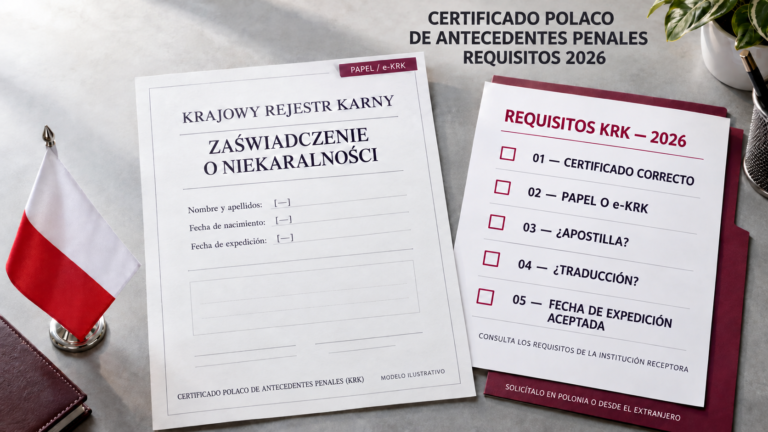
Potrzebujesz zaświadczenia o niekaralności z Polski?
Lex Corporation wspiera klientów w Polsce i za granicą w uzyskaniu zaświadczenia o niekaralności, przygotowaniu pełnomocnictwa, apostille, tłumaczenia przysięgłego oraz międzynarodowej wysyłce dokumentów.
Take Action Today
Do not allow missing paperwork to disrupt your global plans. Let the cross-border specialists at Lex Corporation deliver your certified, apostilled Polish Police Clearance Certificate directly to you.
- Email: info@lexcorporation.pl
- WhatsApp: +48 573 467 138
- Website: Lex Corporation
Scrollable
Prawa cudzoziemca w ośrodku strzeżonym: zdrowie, warunki i skargi
Rights in Immigration Detention in Poland: Health, Conditions and Complaints
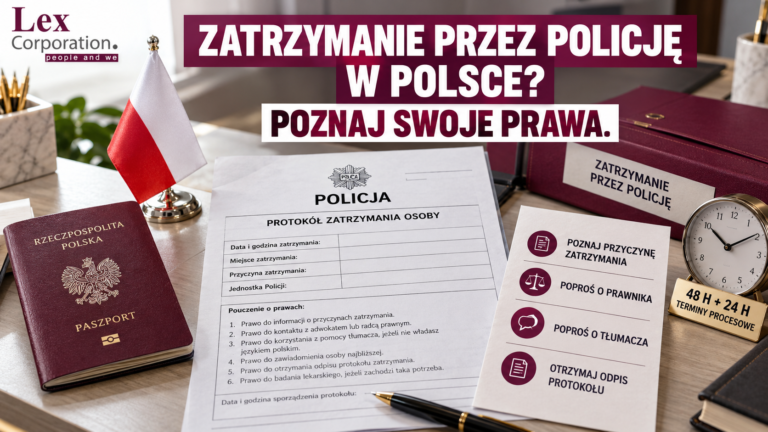
Zatrzymanie cudzoziemca przez policję w Polsce: prawa i dalsze kroki
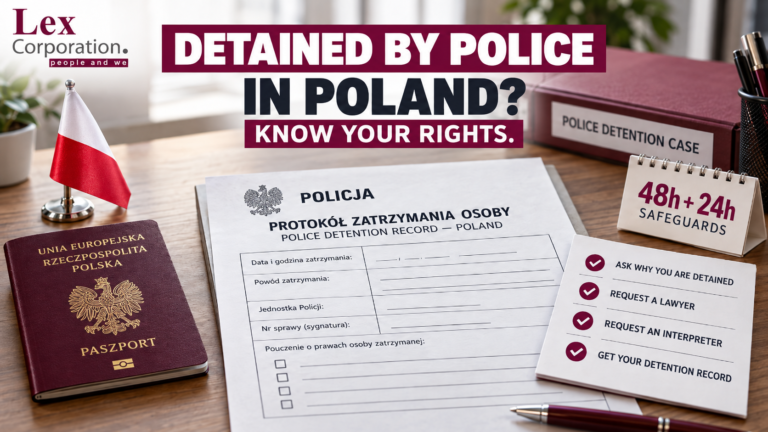
Police Detention in Poland: A Foreigner’s Rights and Next Steps
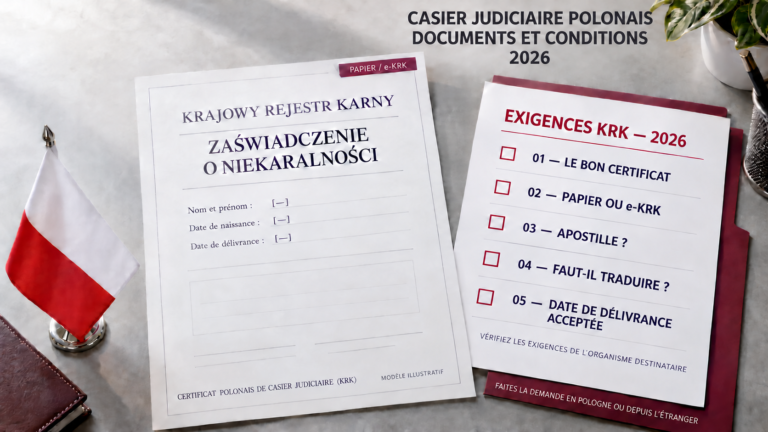
Comment vérifier les conditions d’obtention d’un certificat de casier judiciaire polonais (2026)