A Familiar Wall for Foreign-Owned Companies
Imagine a management board member living in Lisbon, Dubai, or Toronto. They sit on the board of a Polish limited liability company. The company holds full registration with the National Court Register (KRS). It has a NIP, a bank account, and an accountant in Warsaw.
Yet, the process stalls when it is time to sign a financial statement. Authorising a KSeF invoicing account or responding via an e-Doręczenia mailbox causes immediate roadblocks. The reason is almost always the same: the board member lacks a PESEL number. Without it, Poland’s free identity tool, Profil Zaufany (the Trusted Profile), remains completely unavailable to them.
It is a highly common problem for foreign-owned businesses operating in Poland. This issue became even more pressing in 2026 due to tighter PESEL and e-Doręczenia rules. The good news? A fully legal workaround exists. Best of all, it does not involve flying a director to Poland indefinitely.
Why the Foreign Board Member PESEL Problem is Urgent in 2026
Three separate regulatory changes are colliding simultaneously. Together, they explain why this issue now lands on so many corporate desks.
- PESEL applications now require an in-person visit. As of 2026, many non-EU, non-EEA, and Swiss foreigners can no longer apply for a PESEL via a representative or post. This removes a critical workaround that law firms and accountants previously relied on for absent board members.
- e-Doręczenia is now mandatory for KRS-registered companies. Most businesses registered in the National Court Register must maintain a digital delivery address. Setting one up requires an administrator with a Trusted Profile, which explicitly requires a PESEL.
- KSeF is now mandatory for invoicing. Companies authenticate to Poland’s national e-invoicing platform using a qualified electronic seal, a KSeF token, or a KSeF certificate. None of these require a PESEL, but many companies only discover this after their Profil Zaufany route has already failed.
Consequently, a foreign board member can be fully legitimate and authorised, yet still locked out of routine digital administration. All because of a missing eleven-digit number.
Profil Zaufany vs. Certum: Solving the Foreign Board Member PESEL Dilemma
Many business owners assume Profil Zaufany and a qualified electronic signature are interchangeable. They are not. They rest on different legal foundations. This exact difference makes one accessible without a PESEL, while the other requires it.
Profil Zaufany is a free, Polish government-issued identity tool. The state designed it specifically for residents who can easily obtain a PESEL number. By contrast, an EU-certified Trust Service Provider issues a Certum qualified certificate under the strict European eIDAS Regulation. The provider verifies identity directly using a passport or national ID, completely bypassing the Polish national registry number system.
| Requirement | Profil Zaufany (Trusted Profile) | Certum Qualified Certificate (QES / Seal) |
| Issued by | Polish government (free) | Certified EU Trust Service Provider (paid) |
| Requires a PESEL number? | Yes, mandatory | No |
| Requires presence in Poland? | Generally yes, for non-residents | No PESEL appointment needed; verification happens at an authorised partner point |
| Works for KSeF? | No, it authenticates a person | Yes, via a qualified electronic seal issued to the company |
| EU-Wide Recognition? | No, Poland-only | Yes, fully recognized under eIDAS rules |
| Typical validity | 3 years | Up to 3 years with Certum |
Who Encounters This PESEL Obstacle?
- Holding companies and SPVs with a board based entirely outside Poland. Owners often set up these entities purely for investment or tax structuring.
- Startups with a foreign founder who registers a Polish entity remotely. They often use a local law firm without ever relocating to Central Europe.
- Multinationals expanding into Poland. Here, the appointed local director is a regional executive who travels to Warsaw occasionally, rather than living there full-time.
- Companies mid-transition on KSeF tokens. Management used a temporary token to start but now need a long-term, board-authorised method before the system phases temporary options out.
The Solution: How a Qualified Certificate Bypasses the PESEL Requirement
A Certum qualified electronic signature belongs directly to the individual board member. It lets them sign documents requiring a personal declaration of will under Polish law. This includes annual financial statements and KRS filings—completely bypassing the need for a PESEL or Profil Zaufany.
Separately, a Certum qualified electronic seal authenticates the organisation itself for KSeF and official correspondence. We cover this corporate mechanism in detail in our guide to the qualified electronic seal and KSeF. Pair it with this article if your company is currently navigating complex invoicing compliance.
In practice, a foreign-led company can remain fully operational in Poland’s digital systems with:
- A qualified electronic signature for each board member who needs to sign documents personally.
- A qualified electronic seal for the company to handle KSeF authentication and bulk document stamping.
- Zero PESEL applications, no in-person government registry appointments, and no dependency on a Polish bank account.
Identity Verification for Foreign Board Members Without a PESEL
A qualified certificate is not an anonymous shortcut. The eIDAS Regulation requires a rigorous identity check before issuing any certificate. This verification provides the certificate with absolute legal equivalence to a handwritten signature across the EU. The primary difference lies in who performs that check.
Profil Zaufany ties identity to a database record held by the Polish state. A Certum qualified certificate ties identity to a secure verification appointment. An authorised partner point conducts this check using a valid passport. This process is highly practical for a board member visiting Warsaw or using remote verification options. It completely avoids the slow, multi-step process of applying for a local registry number first.
How Lex Corporation Solves Your Polish Digital Setup
We serve as an official authorised partner of Certum by Asseco Data Systems. Our office is centrally located in Warsaw at ul. Krucza 16/22. We conduct identity verification for Certum’s qualified signatures and seals on-site. Because the process avoids the PESEL entirely, it perfectly suits foreign board members who rarely visit Poland.
Depending on your company’s corporate structure, we typically help with:
- Identity verification appointments for international board members requiring personal qualified signatures.
- Qualified electronic seal issuance for the company itself to secure KSeF workflows.
- Strategic guidance on which Certum format fits your setup, such as SimplySign (cloud-based) or a hardware card reader.
- Coordinating signature setups for mixed-residency boards where only some members hold a PESEL.
If your company is navigating KSeF authentication, our Qualified Electronic Seal Guide for Polish Companies walks you through the process step by step. Additionally, if your HR team handles Polish employment contracts, our guide to signing employment contracts online covers that requirement in full. For broader compliance updates, you can also consult official guidelines on the Polish Government Business Portal.
Frequently Asked Questions
Can a foreign board member sign Polish company documents without a PESEL?
Yes. A Certum qualified electronic signature does not require a PESEL number. The provider issues it after verifying a passport or national ID. Under the eIDAS Regulation, it carries the same legal weight as a handwritten signature.
Is Profil Zaufany ever the better option for a foreign director?
If the director already holds a PESEL through Polish residency, Profil Zaufany is free. It works well for routine tasks like ZUS or tax portal access. However, it is not an option for board members lacking a PESEL. In these cases, a qualified certificate becomes the only practical route.
Does the company also need a qualified electronic seal, or just a signature for the director?
It depends on the task. A qualified electronic signature belongs to an individual. You use it when the law requires a personal declaration of will, such as signing financial statements. Conversely, a qualified electronic seal belongs to the company and handles tasks like KSeF authentication. Many foreign-led companies use both tools.
Can identity verification for a Certum certificate happen outside Poland?
Certum works with authorised partner points like Lex Corporation in Warsaw to conduct in-person identity verification. If a board member plans a trip to Poland, scheduling the appointment during their visit is highly efficient.
What happens once PESEL rules tighten further for a board member’s home country?
Tightened PESEL rules affect Profil Zaufany eligibility, not your qualification for a Certum certificate. Since the certificate process never relied on a PESEL, future registry rule changes will not impact board members.
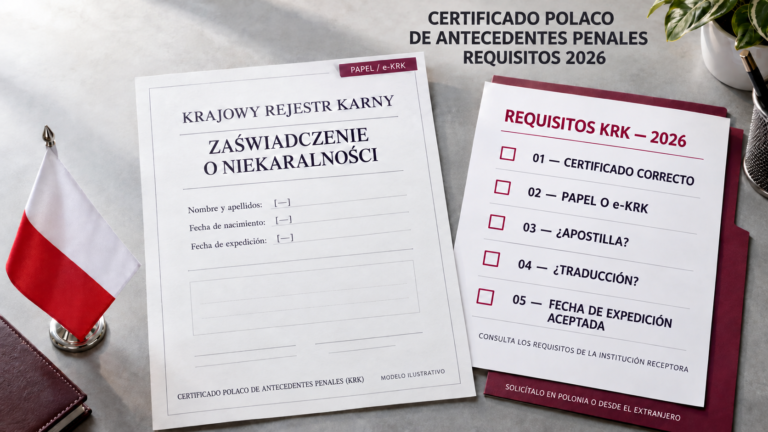
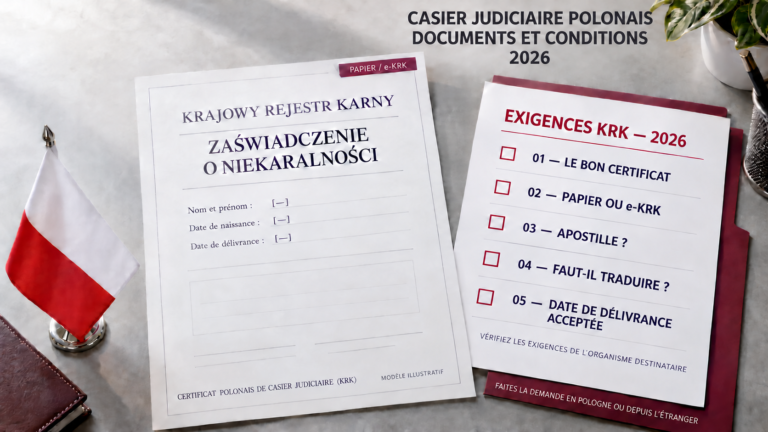
Potrzebujesz zaświadczenia o niekaralności z Polski?
Lex Corporation wspiera klientów w Polsce i za granicą w uzyskaniu zaświadczenia o niekaralności, przygotowaniu pełnomocnictwa, apostille, tłumaczenia przysięgłego oraz międzynarodowej wysyłce dokumentów.
Take Action Today
Do not allow missing paperwork to disrupt your global plans. Let the cross-border specialists at Lex Corporation deliver your certified, apostilled Polish Police Clearance Certificate directly to you.
- Email: info@lexcorporation.pl
- WhatsApp: +48 573 467 138
- Website: Lex Corporation
Grid
Prawa cudzoziemca w ośrodku strzeżonym: zdrowie, warunki i skargi

Rights in Immigration Detention in Poland: Health, Conditions and Complaints
Zatrzymanie cudzoziemca przez policję w Polsce: prawa i dalsze kroki
Police Detention in Poland: A Foreigner’s Rights and Next Steps
Comment vérifier les conditions d’obtention d’un certificat de casier judiciaire polonais (2026)