Introduction: The Invoice Problem That Caught Many Businesses Off Guard
In February 2026, Poland switched on the mandatory phase of KSeF, the national electronic invoicing system. Consequently, by April 1, 2026, it became compulsory for virtually every VAT-registered company operating in Poland. The government no longer accepts PDF and paper invoices as legally valid for B2B transactions. Instead, companies must now pass every invoice through a centralised government platform.
However, here is where many business owners ran into a wall: to use KSeF, your company needs to authenticate itself. Specifically, for legal entities (companies, not individuals), the primary way to do that is with a qualified electronic seal.
If you have been managing your invoicing through accounting software and suddenly face KSeF access questions, or if someone told you that your company “needs a seal,” this guide explains exactly what that means, why it matters, and what you must do about it.
What Is a Qualified Electronic Seal?
A qualified electronic seal is the company-level equivalent of a qualified electronic signature. Where a signature belongs to a person, a seal belongs to an organisation.
Think of it as a digital company stamp, but one that is legally binding, tamper-evident, and automatically recognised across the entire European Union.
For example, when your company applies a qualified electronic seal to a document or invoice:
- First, the recipient knows with certainty that it came from your company.
- Second, they can verify that the content has not changed since you applied the seal.
- Third, the seal carries full legal validity under the [ADD OUTBOUND LINK HERE: EU eIDAS Regulation] across all EU member states.
- Finally, Adobe Reader automatically recognises the seal without any additional configuration (Certum is on the Adobe Approved Trust List).
This is not a scanned image of your company logo, and it is not the digital rubber stamp you might use in a PDF editor. Rather, a qualified electronic seal is a cryptographically secure certificate issued by a certified Trust Service Provider. In Poland, this includes Certum by Asseco Data Systems, one of the longest-established certification authorities in Europe.
The Difference Between an Electronic Seal and an Electronic Signature
Admittedly, this is where most confusion starts. They are two distinct tools that serve different legal purposes.
| Feature | Qualified Electronic Signature | Qualified Electronic Seal |
| Belongs to | A person | A company / legal entity |
| Used for | Signing contracts requiring a personal declaration of will | Authenticating company documents and invoices |
| Required for | Employment contracts, NDAs, KRS filings, financial statements | KSeF authentication, mass invoice stamping, official correspondence |
| eIDAS compliant? | Yes | Yes |
| Recognised across EU? | Yes | Yes |
Therefore, a critical point from Certum’s own guidance is that these two tools are not alternatives to each other. In fact, many businesses use both. The seal handles company-level document authentication and KSeF access. Meanwhile, individual managers and employees use the electronic signature when the law requires their personal declaration of will, for example, on a contract.
Why KSeF Made the Electronic Seal Urgent for Polish Companies
Before KSeF, the qualified electronic seal was useful but not strictly required for most small companies. Businesses usually sent invoices by email as PDFs, and the seal was mainly a nice-to-have for larger organisations.
Undeniably, that changed in 2026.
[ADD OUTBOUND LINK HERE: KSeF (Krajowy System e-Faktur)] is now Poland’s mandatory national electronic invoicing platform. Here is the rollout timeline:
- February 1, 2026: Mandatory for large taxpayers (annual turnover above PLN 200 million)
- April 1, 2026: Mandatory for all other VAT-registered businesses in Poland
- January 1, 2027: Deadline for micro-enterprises
Once mandatory, PDF and paper invoices sent outside KSeF lose their legal validity for B2B transactions. As a result, businesses must submit invoices to the government platform in structured XML format.
To access KSeF on behalf of a company, legal entities must authenticate using one of three methods: a qualified electronic seal, a KSeF token (available only until the end of 2026), or a KSeF certificate for machine-to-machine integrations.
Importantly, the government is phasing out tokens. Moreover, KSeF certificates primarily serve automated IT integrations. Therefore, for ongoing, day-to-day business use by a company, the qualified electronic seal is the standard authentication method, and for many businesses, it is now absolutely essential.
What Does the Seal Actually Let You Do in KSeF?
Once your company holds a qualified electronic seal from a certified provider like Certum, you can:
- Authenticate your company’s KSeF account to issue and retrieve invoices.
- Submit the ZAW-FA authorization form, which lets you formally assign invoice-issuing rights to specific employees or your accounting firm.
- Seal invoices and official correspondence automatically. Because you can apply the seal in bulk, it provides a massive advantage for companies issuing high volumes of documents.
- Access your invoice archive directly from the KSeF platform without relying on your accounting software.
- Operate in KSeF’s offline and emergency modes, which require authenticated document submission.
Beyond KSeF, organizations accept the qualified electronic seal for official company correspondence, outgoing offers and contracts, internal document archiving, employee records, and any situation where you need tamper-proof proof of origin for a company document.
Who Particularly Needs a Qualified Electronic Seal?
While the seal is useful for any Polish company, it is especially important for:
Companies with foreign management or ownership
If your board members or authorised representatives reside outside Poland, the qualified electronic seal allows the company to authenticate with KSeF and official systems without requiring individuals to travel to Poland. Consequently, the person signing company documents can use a qualified electronic signature from their home country, while the company itself operates through the seal.
Businesses with high invoice volumes
Your team can apply the seal automatically and in bulk. Thus, a company issuing hundreds or thousands of invoices per month benefits enormously from a tool that handles KSeF authentication and document stamping at scale, without requiring a person to manually sign each one.
Accounting firms and outsourced accounting providers
If you manage invoicing for multiple clients in Poland, you must understand which authentication method grants your firm access to each client’s KSeF account. The ZAW-FA form, authenticated with a qualified seal or signature, serves as the legal mechanism for delegating these permissions.
Companies in regulated industries
Finance, construction, logistics, and public procurement all involve heavy documentation requirements. A qualified electronic seal creates an auditable, tamper-evident trail for every document it touches. Ultimately, this is vital for compliance and for resolving disputes.
Companies that want to go fully paperless
If you already use a Qualified Electronic Signature for individual document signing, adding a qualified electronic seal completes the picture. Together, they cover almost every document type in a Polish company’s operations, from invoices and financial statements to employment contracts and public procurement bids.
How to Get a Qualified Electronic Seal in Poland
Certum by Asseco Data Systems is one of Poland’s main qualified electronic seal providers and holds a spot on the EU Trusted List. Certum offers two formats:
SimplySign (Mobile App)
Certum stores the seal in a secure cloud, and you use it through a smartphone app with two-factor authentication. You do not have to purchase or carry any hardware. Furthermore, you can apply the seal from a phone, tablet, or computer on any operating system. This is practical for smaller teams or companies where management is not in the same office every day.
Card and Reader
Alternatively, you can store the seal certificate on a physical smart card. Sealing happens from a workstation after you insert the card and enter a PIN code. Generally, this suits environments with stricter IT security policies or regulated industries where teams prefer hardware-based credentials.
Both formats comply with eIDAS and are fully accepted across Polish government systems including KSeF, ePUAP, ZUS, and KRS.
Obtaining the seal requires an identity verification step for the company’s authorized representative. Fortunately, Lex Corporation, as an official Certum partner based in Warsaw, handles this verification in person at our office at ul. Krucza 16/22.
Electronic Seal, KSeF Tokens, and What Happens After 2026
Many companies got through the early phase of KSeF using tokens, temporary digital keys that allow system access without a full seal. While these were practical for a quick start, the government will only allow them until December 31, 2026.
After that date, companies relying on tokens must switch to either a qualified electronic seal or a KSeF certificate. For most businesses without a dedicated IT integration team, the seal provides the most practical long-term solution.
If you set up KSeF access with a token and have not yet looked at what happens when tokens expire, now is the right time to plan the transition.
A Practical Note on Combining Seal and Signature
If your company wants to deploy a qualified electronic seal, you should think about whether key individuals also need a qualified electronic signature. Although they are different tools for different situations, companies frequently use them together.
For instance, the company seal handles KSeF access and stamps outgoing invoices. Conversely, a manager needs their personal QES to sign an employment contract or a financial statement that requires an individual declaration of will. Together, the two cover your company’s complete range of legally required electronic document workflows.
Lex Corporation’s Digital Start programme serves businesses that want to implement both at once, combining seal issuance, electronic signature setup, and implementation guidance in a single package. You can explore that here.
Frequently Asked Questions
Is a qualified electronic seal required for KSeF?
For legal entities (companies), the qualified electronic seal serves as the primary authentication method for KSeF and acts as the standard long-term solution. KSeF tokens were available as a transitional tool, but officials are phasing them out at the end of 2026. Meanwhile, KSeF certificates serve automated machine-to-machine integrations. For day-to-day business access, we strongly recommend the qualified electronic seal.
Can a company outside Poland use a qualified electronic seal for KSeF?
Companies not established in Poland do not have to follow the KSeF obligation, but they may use the system voluntarily. However, for companies that do use KSeF, the authentication requirements remain the same regardless of where the company is headquartered.
What is the difference between a qualified electronic seal and a DocuSign seal?
They are entirely different tools with completely different legal standing. A qualified electronic seal from an EU-certified Trust Service Provider like Certum relies on definitions under the eIDAS Regulation and gains recognition across all EU member states. In contrast, commercial sealing features in tools like DocuSign or Adobe Sign operate at a lower level of assurance and do not carry the same legal equivalence under Polish or EU law.
How long does it take to get a qualified electronic seal?
With Certum’s SimplySign format, Lex Corporation can complete the identity verification and issuance in a single in-person appointment at our Warsaw office. The seal becomes available for use immediately after issuance. Additionally, Certum certificates carry a validity of up to three years, the longest available on the Polish market.
Does the company seal replace individual signatures on contracts?
No. The qualified electronic seal authenticates company documents and is assigned to the legal entity. It cannot substitute for an individual’s qualified electronic signature when the law requires a personal declaration of will, for instance, on an employment contract or a non-competition agreement.
Next Steps
If your company operates in Poland under the KSeF mandate and you are working out how to handle authentication beyond 2026, or if you are setting up a new company and want to build a fully electronic document workflow from the start, the Lex Corporation team can guide you through the options.
We operate as an official authorised partner of Certum by Asseco Data Systems, based in Warsaw. We handle identity verification for seal and signature issuance, advise on which format fits your business, and support implementation across HR, accounting, and compliance document flows.
Visit our Electronic Seal service page for current Certum products and pricing, or book a consultation with our team directly. You can also reach us at info@lexcorporation.pl or in person at ul. Krucza 16/22, Warsaw.
For companies that also need to address employment contracts, remote work agreements, or individual qualified electronic signatures across their HR team, see our related guide: Can You Sign an Employment Contract Online in Poland?
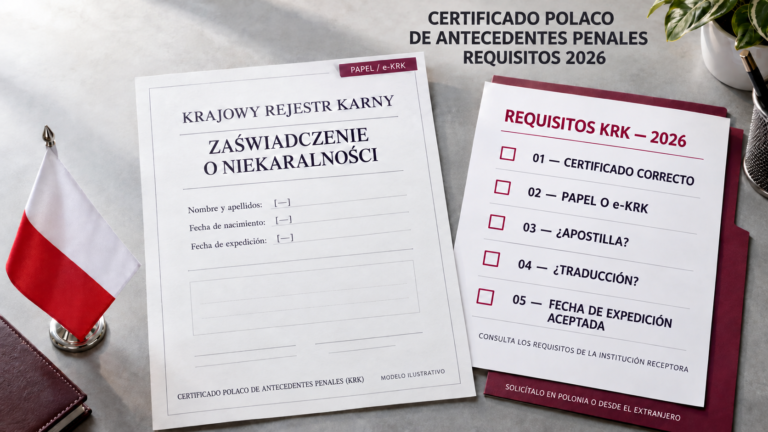
Potrzebujesz zaświadczenia o niekaralności z Polski?
Lex Corporation wspiera klientów w Polsce i za granicą w uzyskaniu zaświadczenia o niekaralności, przygotowaniu pełnomocnictwa, apostille, tłumaczenia przysięgłego oraz międzynarodowej wysyłce dokumentów.
Take Action Today
Do not allow missing paperwork to disrupt your global plans. Let the cross-border specialists at Lex Corporation deliver your certified, apostilled Polish Police Clearance Certificate directly to you.
- Email: info@lexcorporation.pl
- WhatsApp: +48 573 467 138
- Website: Lex Corporation
List
Prawa cudzoziemca w ośrodku strzeżonym: zdrowie, warunki i skargi

Rights in Immigration Detention in Poland: Health, Conditions and Complaints
Zatrzymanie cudzoziemca przez policję w Polsce: prawa i dalsze kroki
Police Detention in Poland: A Foreigner’s Rights and Next Steps
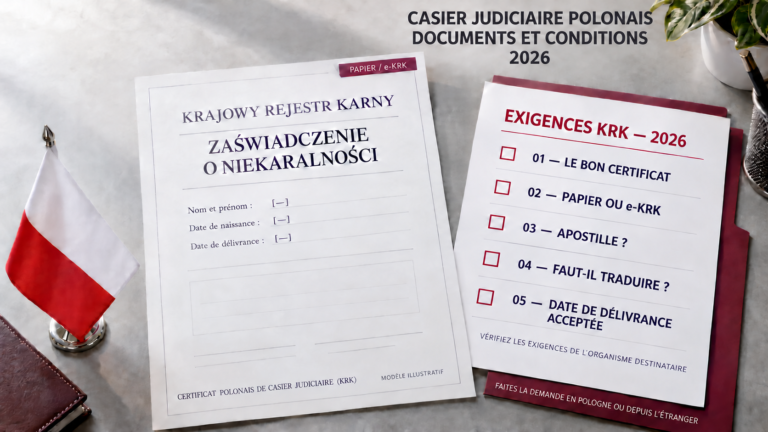
Comment vérifier les conditions d’obtention d’un certificat de casier judiciaire polonais (2026)